
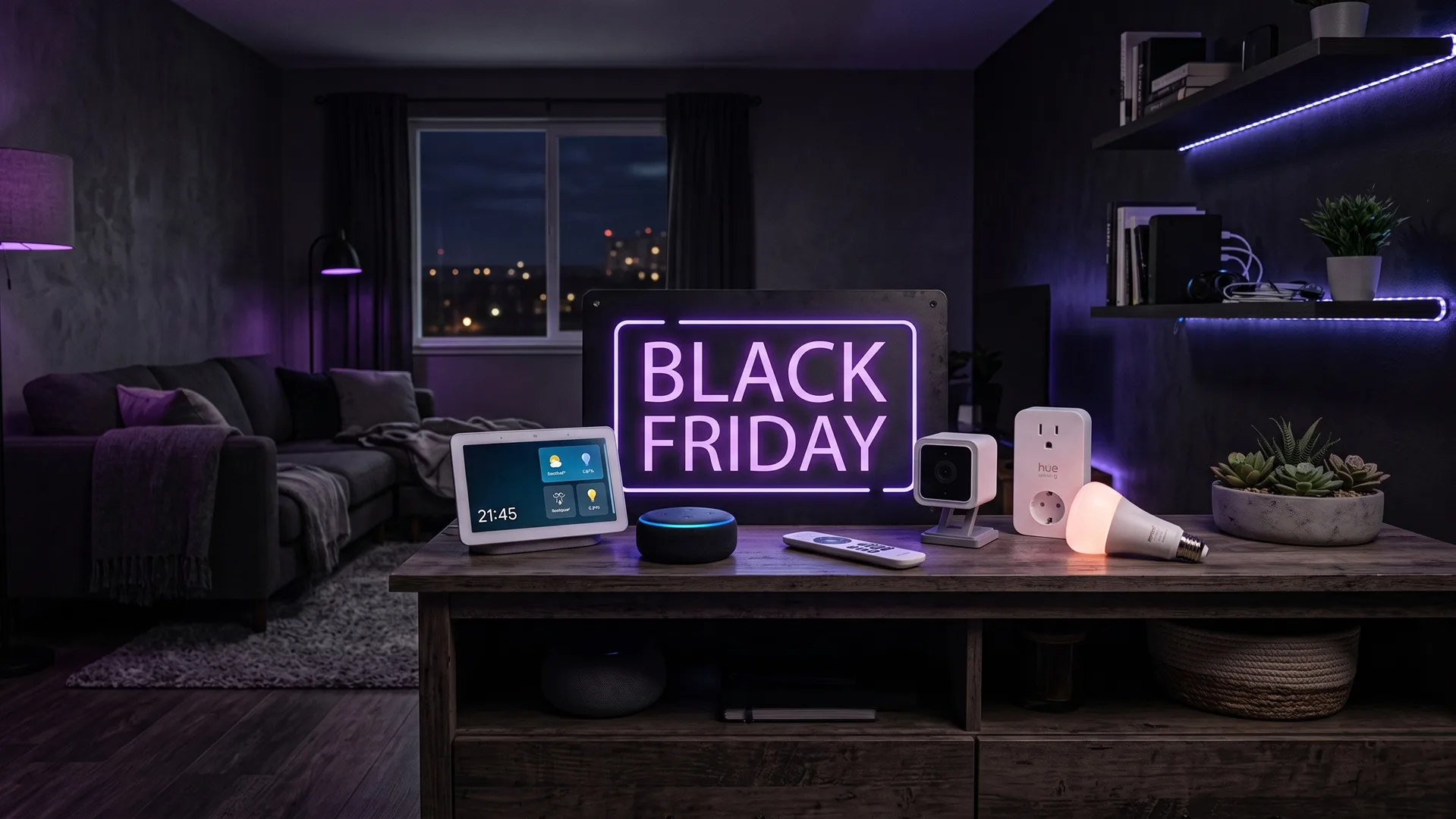
The smart home category is, year after year, one of the categories that tends to bring the most genuine discounts on Black Friday — but also one of the most confusing for anyone starting from scratch.
Between speakers, bulbs, sockets, cameras, and a dozen different protocols, it is easy to end up buying pieces that never work well together. This guide is not a deals list — it is what you need to know before November so you spend wisely when the discounts arrive.

The idea is simple: decide what kind of smart home you want to build before choosing products, because Black Friday tends to bring good prices across virtually every subcategory — and the wrong choice is not the price, it is buying incompatible pieces.

Smart speakers and voice assistants
This is usually the entry point for beginners and also where Black Friday tends to bring the most aggressive discounts — speakers that normally cost between €50 and €100 can easily drop to half price.
Before choosing between Amazon Alexa, Google Assistant, or Apple’s own assistants, it is worth checking which assistant you already use on your phone — that matters more in daily use than the sound quality of the speaker itself.
Anyone who just wants to control lights and sockets by voice does not need the top-of-the-range model — an entry-level option works perfectly well.

Smart lighting
Philips Hue remains the category benchmark, but also the most expensive — and Black Friday is usually the only time of year when starter kits drop to a price that genuinely makes sense even for those just wanting to try it out.
For those who do not want to spend as much, brands such as Xiaomi, TP-Link Tapo, and Govee offer bulbs and LED strips at significantly lower prices — between €10 and €25 per bulb on promotion — with reasonable integration across the main assistants, though without some advanced features such as individual colour control across the full Hue range.
The question to ask before buying is whether you just want to switch lights on and off by voice, or whether you want scenes and more complex automations — that determines whether paying more is worthwhile.

Sockets, sensors, and simple automation
This is the most affordable category and the one that tends to deliver the most immediate return — smart sockets hover around €10 to €20 even outside sale periods, and door, motion, or temperature sensors typically come in below €15.
It is also where paying attention to the protocol matters most. Products with Matter — the new standard that several brands have already adopted — tend to remain relevant for longer than solutions locked into a single ecosystem, and that is a criterion that weighs more in the long run than the two or three euro difference between brands.
The Sonoff Fusion range is one of the best solutions for integrating into the home.

Cameras and home security
This is the subcategory where reading the fine print before buying on impulse matters most.
Many smart cameras have an attractive upfront price but hide a mandatory monthly subscription for cloud storage — which over time can cost more than the camera itself.
It is worth confirming whether the model records to a local card at no extra cost before deciding, and comparing the camera’s standalone price with the total cost after a year of subscription — because that is where the real difference shows up.
In this category we recommend Reolink solutions.

Hubs and compatibility — what really matters
If you already have two or three of these categories at home, a central hub can be worth the investment — but only if it is compatible with what you already own.
The simplest rule is to always check for the Matter label or the brand’s compatibility list before buying any new piece, because a smart home built gradually across several Black Fridays only works well if all the pieces keep speaking the same language.
Closer to the date of Black Friday 2026, you can check back on this guide for the first confirmed discounts in the smart home category.
Sobre o autor

Aproveite a campanha:


